 Skip to content
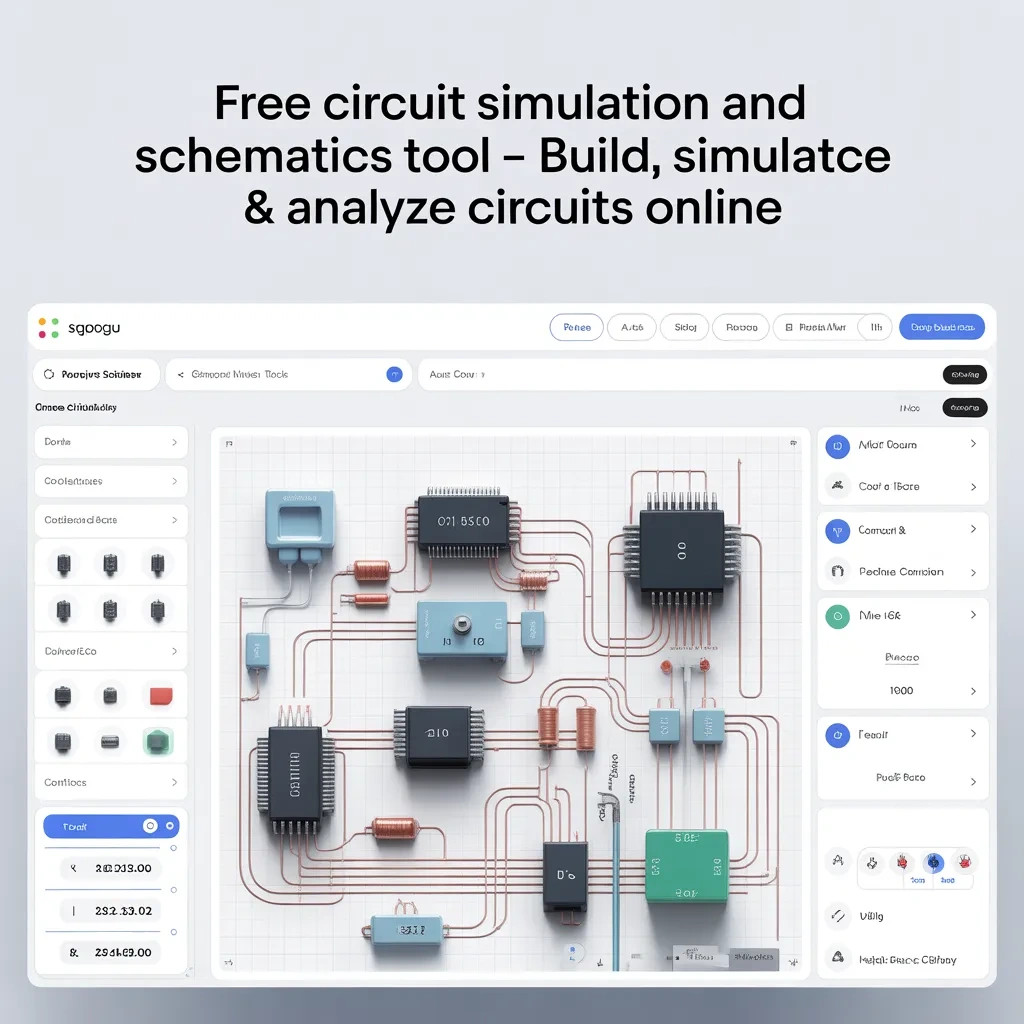
An online circuit simulator is a browser-based tool that lets you design, test, and analyze electronic circuits without installing any software. It works by using a simulation engine, often based on Spice (Simulation Program with Integrated Circuit Emphasis) (SPICE), to calculate voltage, current, and signal behavior in real time.
This type of circuit simulation software helps users build circuits directly in a browser, run simulations instantly, and view results using graphs or an oscilloscope. It supports analog circuit simulation, digital circuit simulation, and mixed-signal simulation in one place.
There are 5 main benefits of an online circuit simulator:
- Fast access from any device
- No installation required
- Real-time simulation data
- Easy learning for beginners
- Support for complex circuits
Users apply this tool in 3 main areas:
- Education (interactive Electronics Textbook)
- Engineering (circuit design and testing)
- Hobby projects (DIY electronics)
An online simulation tool includes 4 core components:
- Schematic editor
- Component library
- Simulation engine
- Waveform viewer (oscilloscope)
Build and simulate circuits right in your browser.
To build and simulate circuits in a browser, open the tool, place components, connect wires, and run the simulation. The system processes data instantly using cloud-based SPICE simulation.
There are 6 simple steps to simulate a circuit online:
- Select components from the library
- Place them on the schematic editor
- Connect components using wires
- Set values like voltage or resistance
- Run the simulation
- Analyze the results
This workflow makes circuit design online simple and fast compared to traditional tools like LTspice, Multisim, Tina-TI, EveryCircuit, CircuitJS, Falstad Circuit Simulator, Autodesk EAGLE, KiCad, Proteus VSM, and SystemVision Cloud.
A browser-based circuit simulator supports:
- Analog circuits (resistors, capacitors, diodes)
- Digital circuits (logic gates, flip-flops)
- Mixed-signal systems (combined analog + digital)
- Real-time component analysis
This makes it one of the best online circuit simulator options available today.
Interactive Electronics Textbook
An interactive Electronics Textbook improves learning by combining theory with live simulation.
To learn electronics faster, use simulation while studying concepts.
There are 5 main topics covered:
- Ohm’s Law and Kirchhoff’s Laws
- Analog circuit behavior
- Digital circuit logic
- AC analysis and frequency response
- Transient response
Students can test circuits instantly instead of only reading theory. This improves understanding and reduces mistakes.
Electronics Questions and Answers
Electronics Questions and Answers sections provide clear solutions with working circuits.
These sections help solve problems quickly using real examples.
There are 4 benefits:
- Step-by-step explanations
- Real circuit demonstrations
- Verified simulation results
- Faster learning
Common questions include:
- How to design a voltage divider
- How a transistor works
- How to build a 555 timer circuit
- How to create logic circuits
This makes the platform useful for both beginners and advanced users
Examples
Examples help users understand how an electronic circuit simulator works in real situations.
There are 5 common circuit examples:
- LED circuit simulation
- Amplifier circuit
- Power supply design
- Digital counter
- Oscillator circuit
Each example shows schematic capture online and simulation results.
Easy-to-use Power Tools
Easy-to-use Power Tools help users design circuits faster and more accurately.
There are 6 important features:
- Drag-and-drop interface
- Auto wiring
- Real-time updates
- Component search
- Instant simulation results
- Clean user interface
Advanced tools include:
- Parametric sweep analysis
- Monte Carlo circuit testing
- Automated circuit optimization
- Custom component creation
- Behavioral model integration
- Advanced node exploration
These features make the tool a complete electronics design software.
Circuits are Better Animated
Circuits are better animated because animation shows how signals move and change over time.
Visualize
To visualize circuits, run the simulation and watch values change instantly.
There are 4 visualization methods:
- Voltage color mapping
- Current flow animation
- Graph plots
- Oscilloscope display
Visualization improves understanding of circuit behavior.
Simulate
To simulate circuits, the system solves equations using nodal and mesh analysis.
There are 5 simulation types:
- DC analysis
- AC analysis
- Transient analysis
- Frequency domain analysis
- Thermal simulation
These methods provide accurate results for circuit analysis.
Interact
To interact with circuits, change component values during simulation.
There are 4 interaction features:
- Adjust resistance live
- Turn switches on/off
- Inject signals
- Modify parameters
Interactive circuit prototyping helps test ideas quickly.
Millions of Circuits Designed by Users
Users designed and simulated millions of circuits using online tools.
Users designed and simulated millions of circuits.
There are 3 reasons for high usage:
- Easy browser access
- Free circuit simulator options
- Large component libraries
Users include students, engineers, and hobbyists.
Explore public circuits at the Gallery.
The Gallery allows users to explore public circuits.
There are 5 benefits:
- Learn from real projects
- Reuse circuit designs
- Understand complex systems
- Compare solutions
- Improve skills
Public circuits include:
- Arduino projects
- Amplifiers
- Digital logic systems
- Power electronics
- RF circuits
This creates a collaborative circuit design environment.
Features: Powerful and Beautiful
Circuits come alive with uninterrupted flow of simulation data.
Simulation runs continuously without interruption.
There are 4 advantages:
- Real-time updates
- Smooth animations
- Accurate calculations
- Better debugging
Dynamic oscilloscopes open new angles for circuit analysis.
A dynamic oscilloscope shows voltage and current over time.
There are 5 uses:
- Analyze waveforms
- Measure frequency
- Detect noise
- Study distortion
- Perform signal integrity analysis
Analog and digital circuits
The simulator supports both analog and digital circuits in one environment.
Examples:
- Amplifiers
- Logic gates
- Microcontroller systems
I-V curve characteristics
I-V curve characteristics show the relationship between current and voltage.
There are 3 uses:
- Analyze diodes
- Study transistors
- Test components
AC analysis with Bode plot
AC analysis shows frequency response using a Bode plot.
There are 4 outputs:
- Gain
- Phase
- Bandwidth
- Cutoff frequency
Oscillator orbit evolution
Oscillator orbit evolution shows signal stability over time.
There are 3 uses:
- Study oscillation behavior
- Analyze feedback systems
- Observe waveform changes
Analog and digital components can be simulated together in one circuit.
Mixed simulation improves accuracy.
There are 4 benefits:
- Real-world testing
- Fewer errors
- Faster design
- Complete system analysis
Simple Pricing
One-time payment buys you online and mobile apps, forever.
A one-time payment provides lifetime access.
There are 3 advantages:
- No monthly fees
- Full features
- Long-term use
One in-app purchase buys you mobile and online apps, forever.
One purchase connects all platforms.
There are 3 benefits:
- Sync data
- Access anywhere
- Use on multiple devices
Free
The Free plan includes:
- Basic components
- Limited circuits
- Standard simulation
- Gallery access
$15 / forever
The $15 plan includes:
- Unlimited circuits
- Full library
- Advanced tools
- No ads
- Priority support
$4 / semester
The $4 plan is for students.
It includes:
- Full access
- Low cost
- Flexible duration
- Education support
Platforms
Supported platforms:
- Web browser
- Mobile apps
- Tablets
Circuits
Supported circuit types:
- Analog circuits
- Digital circuits
- Mixed-signal circuits
- Power circuits
- RF circuits
Company
Company services include:
- Simulation software
- Educational tools
- Cloud-based systems
Summary
An online circuit simulator is a browser-based circuit simulation software that allows users to design, simulate, and analyze circuits in real time. It supports analog circuit simulator, digital circuit simulator, and mixed-signal simulation.
Users can visualize, simulate, and interact with circuits using schematic tools, simulation engines, and waveform viewers. The platform includes an interactive Electronics Textbook and Electronics Questions and Answers to support learning.
Features like oscilloscope, I-V curve characteristics, AC analysis with Bode plot, and oscillator orbit evolution improve circuit analysis. Pricing options include Free, $15 forever, and $4 semester plans with access across browser and mobile apps.
