 Skip to content
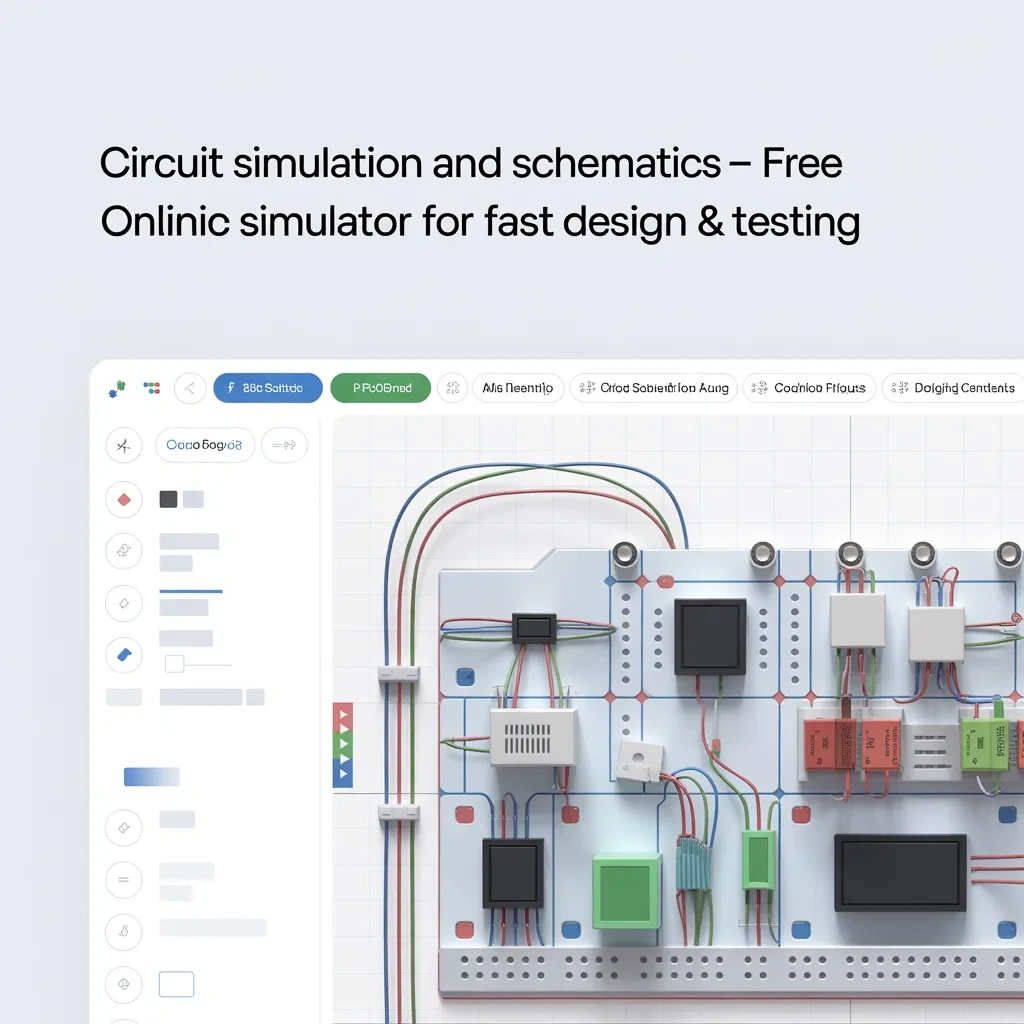
A circuit simulator is a software tool that allows users to design, test, and analyze electronic circuits before building them physically. It works by using mathematical models, usually based on SPICE (Simulation Program with Integrated Circuit Emphasis), to calculate voltage, current, and signal behavior across components in real time.
A modern online circuit simulator runs directly in a browser. This means users can access circuit simulation software without installing any application. The system processes circuit data instantly and shows results through graphs, waveform viewers, and an oscilloscope.
There are 5 main benefits of using a circuit simulator:
- Fast circuit design and testing
- Accurate circuit analysis results
- No hardware cost during early testing
- Easy learning for beginners
- Support for analog, digital, and mixed-signal circuits
There are 4 main uses of circuit simulation:
- Learning electronics concepts
- Designing PCB circuits
- Testing power electronics systems
- Analyzing RF and communication circuits
A circuit simulator includes 5 core components:
- Schematic editor for drawing circuits
- Component library with electronic parts
- Simulation engine for calculations
- Analysis tools for DC, AC, and transient behavior
- Waveform viewer or oscilloscope for results
Circuit simulation and schematics together create a complete system where users can design circuits visually and verify performance before real-world implementation.
Build and Simulate Circuits Right in Your Browser
To build and simulate circuits right in your browser, open an online circuit simulator, select components, connect them, and run simulation. The system solves equations using nodal analysis and displays real-time results.
There are 6 steps to simulate a circuit online:
- Select components from the component library
- Place them in the schematic editor
- Connect nodes using wires
- Assign values such as resistance or voltage
- Run the simulation engine
- Analyze waveform outputs
This process makes circuit design online simple and efficient.
A browser-based circuit simulator supports different types of circuits:
- Analog circuits such as amplifiers and filters
- Digital circuits such as logic gates and counters
- Mixed-signal circuits combining analog and digital
- Power electronics circuits
- RF circuits for communication systems
There are 5 main analysis methods used in circuit simulation software:
- DC Analysis: calculates steady-state voltage and current
- AC Analysis: studies frequency response
- Transient Analysis: shows signal behavior over time
- Monte Carlo Analysis: tests variations in component values
- Thermal Simulation: analyzes heat effects in circuits
These analysis tools provide accurate simulation results and help users understand circuit behavior in different conditions.
Circuit simulator software replaces manual calculations and reduces errors. It also improves design speed and reliability.
Interactive Electronics Textbook
An Interactive Electronics Textbook combines theory with simulation.
To learn electronics effectively, use a circuit simulator while studying concepts.
There are 5 key topics covered in an interactive textbook:
- Basic Electronics laws such as Ohm’s Law
- Analog circuit simulation
- Digital circuit design
- AC and DC analysis
- Transient response
Students can build circuits and see how they behave instantly. This method improves learning compared to reading only theory.
There are 4 main advantages of using an interactive Electronics Textbook:
- Immediate feedback after simulation
- Visual understanding of circuit behavior
- Practical experience with real circuits
- Faster concept learning
This approach helps beginners understand complex topics such as signal flow, voltage distribution, and component behavior.
An interactive system also supports circuit simulator tutorial features where users follow guided steps to build circuits.
Electronics Questions and Answers
Electronics Questions and Answers sections provide direct solutions with practical circuit examples.
These sections answer common electronics problems using simulation.
There are 4 key benefits:
- Step-by-step solutions
- Real circuit examples
- Verified simulation results
- Quick problem-solving
Common topics include:
- Voltage divider circuits
- Transistor switching
- 555 timer applications
- Digital logic design
Each answer includes a working circuit schematic and simulation output. This helps users understand how circuits behave under different conditions.
Electronics Questions and Answers improve circuit analysis skills and support both beginners and professionals.
Examples
Examples are important for understanding how a circuit simulator works in real situations.
There are 5 common circuit examples:
- LED circuit design
- Audio amplifier circuit
- Power supply simulation
- Digital counter circuit
- Oscillator circuit
Each example includes:
- Schematic diagram
- Simulation setup
- Output waveform
These examples help users understand electronic circuit simulation step by step.
Practical examples also improve problem-solving skills and reduce design errors.
Easy-to-use Power Tools
Easy-to-use Power Tools simplify circuit design and simulation.
There are 6 main features:
- Drag-and-drop interface
- Automatic wiring
- Real-time simulation updates
- Component search system
- Built-in templates
- Clean interface
These features make the circuit simulator easy for beginners.
There are 6 advanced capabilities:
- Monte Carlo yield analysis
- Behavioral model integration
- Automated circuit optimization
- Signal integrity analysis
- Power integrity verification
- Thermal aware simulation
These tools help engineers design accurate circuits.
Advanced circuit simulators also support:
- SPICE modeling for accurate simulation
- Verilog-AMS for mixed-signal systems
- VHDL-AMS for complex circuit design
These technologies allow simulation of large systems including embedded circuits.
Circuit simulation tools are widely used in electronics design automation (EDA).
Report an issue
To report an issue in a circuit simulator, follow these steps:
- Open the support or help section
- Describe the issue clearly
- Attach circuit files or screenshots
- Submit the report
There are 4 common issues users report:
- Simulation errors
- Convergence problems
- Component model issues
- Performance lag
Providing detailed information helps developers fix problems quickly.
Advanced Circuit Simulation Concepts
Advanced circuit simulation includes deeper analysis methods used by professionals.
There are 6 advanced simulation techniques:
- Parameter sweep analysis
- Worst-case corner analysis
- Signal integrity analysis
- Power integrity analysis
- Electromagnetic simulation
- High-speed digital simulation
These techniques improve circuit performance and reliability.
Mixed-signal simulation allows analog and digital components to work together. This is important in modern electronics systems.
RF circuit simulation supports high-frequency circuit design. It includes S-Parameter Simulation for signal behavior analysis.
Power electronics simulation focuses on high voltage and current systems such as converters and inverters.
Circuit Simulator vs Traditional Design
A circuit simulator provides several advantages over traditional circuit design.
There are 5 differences:
- Simulation is faster than physical testing
- Errors are easier to fix
- No component cost during testing
- Results are more detailed
- Design changes are instant
Traditional design requires physical components and testing equipment. Circuit simulation software removes these limitations.
Best Circuit Simulator Software
There are many circuit simulator tools available.
Popular tools include:
- LTspice
- Multisim
- OrCAD
- PSpice
- Simulink
- Tina-TI
- Qucs
- Ngspice
- Xyce
These tools provide different features for circuit design and simulation.
Some tools focus on beginners, while others support advanced engineering applications.
Circuit Simulator for Beginners
A circuit simulator for beginners should be simple and easy to use.
There are 5 features beginners should look for:
- Simple interface
- Basic component library
- Real-time simulation
- Visual results
- Free access
Online circuit simulators are ideal for beginners because they run in a browser and require no installation.
Beginners can start with simple circuits such as LED circuits and gradually move to complex designs.
Circuit Simulator for Professionals
Professional circuit simulation software includes advanced features.
There are 6 features used by professionals:
- Advanced SPICE algorithms
- Custom component models
- High-speed simulation
- RF analysis tools
- Thermal simulation
- PCB design integration
These tools are used in industries such as electronics manufacturing and communication systems.
Future of Circuit Simulation
Circuit simulation is improving with new technology.
There are 4 future trends:
- Cloud-based simulation
- AI-assisted circuit design
- Faster simulation engines
- Integration with PCB design tools
Online circuit simulator tools are becoming more powerful and accessible.
Conclusion
A circuit simulator is a powerful circuit simulation software that allows users to design, simulate, and analyze circuits using schematics and real-time data. It supports analog circuit simulation, digital circuit simulation, and mixed-signal simulation.
Users can build circuits in a browser, run DC Analysis, AC Analysis, Transient Analysis, and Monte Carlo Analysis, and view results using waveform tools.
The system includes an Interactive Electronics Textbook and Electronics Questions and Answers to improve learning. Examples and Power Tools help users design and test circuits efficiently.
Advanced features such as SPICE modeling, thermal simulation, and signal integrity analysis provide accurate results for complex circuits.
Circuit simulation remains an essential tool in Electronics for students, engineers, and designers who need fast, accurate, and cost-effective circuit analysis.
