 Skip to content
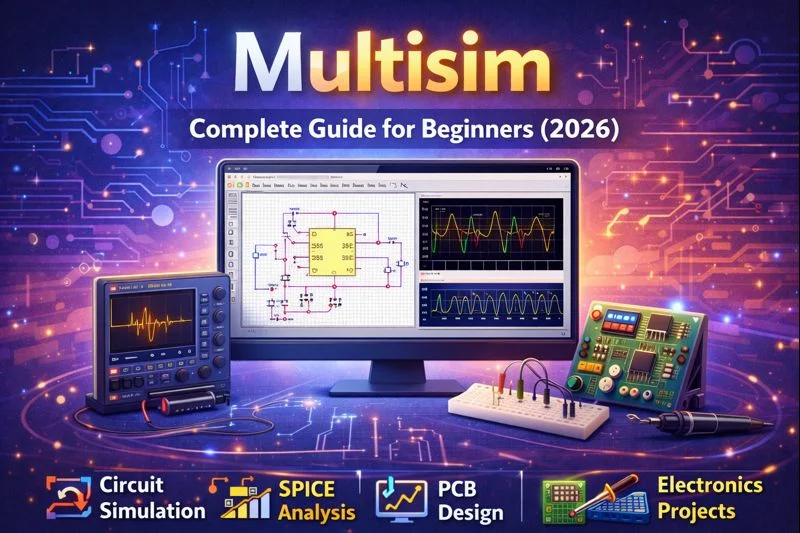
Multisim is a powerful electronic circuit design and simulation software widely used by students, engineers, and hobbyists. It allows users to create, simulate, and analyze electrical circuits in a virtual environment before building them physically. In 2026, Multisim remains one of the most trusted tools in electronics education and industry.
What Is Multisim?
Multisim is a circuit simulation and design software developed by National Instruments. It combines schematic capture, SPICE simulation, and interactive components to help users test and troubleshoot circuits digitally.
With Multisim, you can:
- Design analog, digital, and mixed-signal circuits
- Test circuit functionality without physical components
- Learn electronics concepts interactively
- Analyze circuits using built-in measurement tool
History of Multisim
Multisim was first developed by Analog Devices and later acquired by National Instruments. Over the years, it has evolved into a professional-grade tool used in:
- Universities and schools for teaching electronics
- Engineering companies for circuit design
- Hobbyists and makers for prototyping
Key Features of Multisim
Multisim offers a wide range of features that make it a versatile tool for circuit design:
- Schematic Capture
- Draw circuits using virtual components
- Easily connect resistors, capacitors, transistors, ICs, and more
- SPICE Simulation
- Run simulations using the industry-standard SPICE engine
- Analyze voltage, current, and power across components
- Interactive Components
- Use digital multimeters, oscilloscopes, signal generators, and virtual instruments
- Monitor real-time behavior of the circuit
- Breadboard View
- Visualize the circuit like a real breadboard
- Prepare for physical prototyping
- Educational Resources
- Built-in tutorials and example circuits
- Suitable for students learning electronics
- Advanced Analysis Tools
- AC/DC analysis
- Transient response
- Fourier analysis
- PCB Integration
- Design circuits and export to PCB layout software for manufacturing
Types of Circuits You Can Design in Multisim
Multisim supports a variety of circuit types:
- Analog Circuits
- Resistors, capacitors, transistors, op-amps
- Digital Circuits
- Logic gates, flip-flops, counters
- Mixed-Signal Circuits
- Combination of analog and digital components
- RF Circuits
- Filters, amplifiers, oscillators
- Power Electronics Circuits
- Inverters, converters, motor drivers
How Multisim Works
Multisim works in three main steps:
- Schematic Capture:
Draw your circuit using components from the Multisim library. Components include resistors, capacitors, ICs, diodes, LEDs, and microcontrollers. - Simulation:
Run the SPICE simulation to analyze voltage, current, and signals. Observe waveforms using virtual oscilloscopes and meters. - Analysis & Optimization:
Check the results, modify component values, and optimize circuit performance before building the physical circuit.
Supported Components in Multisim
Multisim offers thousands of pre-built components:
- Passive Components: Resistors, capacitors, inductors
- Active Components: Diodes, transistors, MOSFETs, op-amps
- Digital Components: Logic gates, counters, flip-flops
- ICs and Microcontrollers: 555 Timer, 7400 series, Arduino, PIC
- Virtual Instruments: Oscilloscopes, function generators, multimeter
Benefits of Using Multisim
1. Learn Electronics Easily
Students can practice circuit building without hardware.
2. Reduce Cost
No need to buy physical components for testing circuits.
3. Time Efficiency
Simulate and troubleshoot circuits instantly.
4. Accurate Analysis
SPICE simulation provides realistic results.
5. Error Reduction
Detects circuit errors before building physically.
6. Professional Prototyping
Engineers can design circuits and export to PCB software.
Practical Applications of Multisim
1. Education
- Students use Multisim to understand circuit theory and practice experiments digitally.
2. Electronics Projects
- Hobbyists and makers can design circuits like LED blinkers, audio amplifiers, and motor controllers.
3. Research
- Engineers use Multisim to simulate advanced analog, digital, and power electronics circuits.
4. Industry
- Multisim is used in product prototyping, helping reduce errors and development time.
Multisim vs Other Circuit Simulation Tools
| Feature | Multisim | LTSpice | Proteus | TINA-TI |
| User Interface | Easy, drag-and-drop | Advanced, text-based | GUI + Microcontroller simulation | GUI-based |
| Educational Use | Excellent | Medium | Medium | Medium |
| SPICE Simulation | Built-in | Built-in | Limited | Built-in |
| Digital Simulation | Yes | Limited | Yes | Limited |
| PCB Integration | Yes | No | Yes | Yes |
How to Get Started with Multisim
Step 1: Install Multisim
- Download from National Instruments official site
- Choose version (student, professional, or trial)
- Install and activate
Step 2: Create a New Circuit
- Open Multisim
- Select New Schematic
- Add components from the library
Step 3: Connect Components
- Use wires to connect pins
- Ensure proper orientation of components
Step 4: Run Simulation
- Click Simulate
- Observe voltage, current, and signals on instruments
Step 5: Analyze Results
- Modify component values if needed
- Optimize circuit performance
Tips for Beginners
- Start with simple circuits like voltage dividers or LED circuits
- Use built-in tutorials to understand basic features
- Familiarize with SPICE analysis tools
- Always label components and nets for clarity
- Practice mixing analog and digital circuits for real-world projects
Advanced Features in Multisim
- Fourier Analysis: Observe frequency components of signals
- Monte Carlo Analysis: Test circuit stability under component variations
- Transient Analysis: Observe real-time behavior of signals
- Parameter Sweeps: Optimize resistor, capacitor, and inductor values
- Microcontroller Simulation: Simulate Arduino and PIC-based projects
Multisim for Students and Hobbyists
For students, Multisim is a learning platform:
- Learn Ohm’s Law, Kirchhoff’s Laws, and transistor operation
- Practice AC/DC circuits, filters, and amplifiers
- Test logic gates and flip-flops digitally
For hobbyists:
- Build audio amplifiers, LED controllers, and robotic circuits
- Experiment without risk of burning components
- Share circuits online
Common Problems & Solutions
Circuit Not Simulating
- Check component connections
- Ensure correct power supply
- Verify SPICE model availability
Error in Voltage or Current
- Check resistor/capacitor values
- Confirm orientation of polarized components
Software Crashes
- Update to latest Multisim version
- Clear cache or restart computer
Future of Multisim (2026 & Beyond)
In 2026, Multisim continues to evolve:
- Improved UI/UX for students and engineers
- Enhanced SPICE simulation accuracy
- Integration with PCB design tools like Ultiboard
- Cloud-based collaboration for teams
- Support for IoT and embedded systems simulation
FAQs About Multisim
Q1: Is Multisim free for students?
Yes, National Instruments offers a student edition with limited features.
Q2: Can I simulate microcontrollers in Multisim?
Yes, Multisim supports Arduino, PIC, and other microcontroller simulations.
Q3: Is Multisim compatible with Windows 11?
Yes, the latest versions are fully compatible.
Q4: Can I export Multisim circuits to PCB?
Yes, you can export designs to Ultiboard for PCB layout.
Q5: Is Multisim good for beginners?
Absolutely! It is beginner-friendly and widely used in educational institutes.
Final Thoughts
Multisim is a versatile and professional-grade tool for anyone interested in electronics. Whether you are a student learning circuit theory, a hobbyist building projects, or an engineer designing complex circuits, Multisim provides:
- Accurate SPICE simulation
- Interactive virtual components
- Extensive component library
- Real-time analysis with virtual instruments
- PCB integration for prototyping
